


Akida Execution in Heterogeneous Environments
Two AI Brains Are Better Than One
By Nikunj Kotecha, Senior Solutions Architect
Split the work between a small AI engine that senses all day and a big one that thinks only when needed. Phones already do it. Most other smart devices should too.
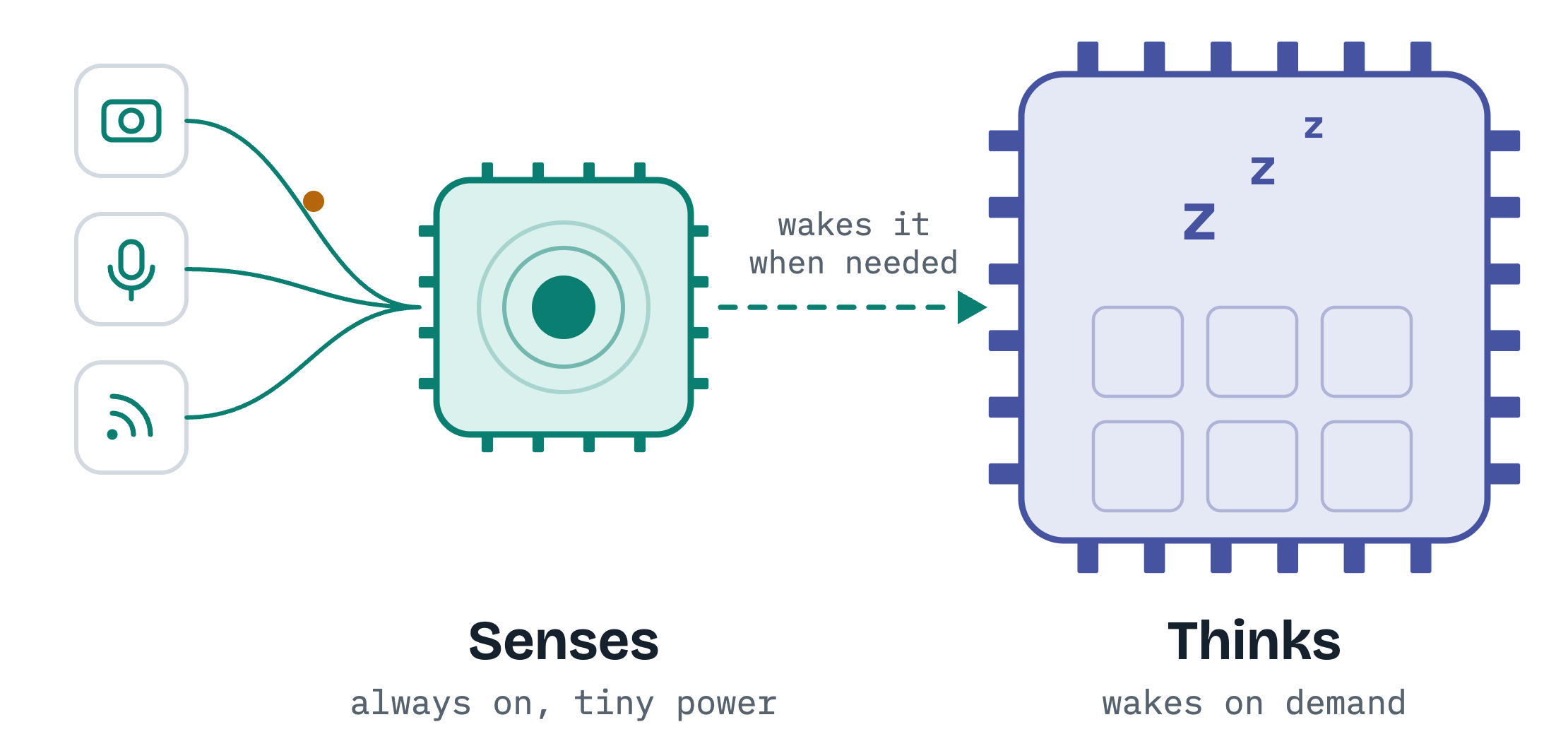
Figure 1. Two kinds of AI brain. A small, always-on engine watches the sensors and wakes the big processor only when something matters.
Most of the time, nothing happens. The room is empty. The motor sounds normal. Nobody said the wake word. A sensor watching the world produces a steady stream of data, and nearly all of it says the same thing: no change.
That matters because more devices are now expected to pay attention all the time. Doorbells listen for a knock, earbuds for a voice, factory sensors for a failing bearing, wearables for a fall. Many run on batteries, and most can’t stream everything to the cloud: the link drains power, adds delay and sends private data off the device. So the AI has to run locally, at the edge, on a tight power budget.
Thinking works the other way. It comes in bursts, such as a question, a face at the door or an odd vibration, and each burst needs a lot of compute quickly.
Ask one big processor to do both jobs and it stays awake all day, spending power to confirm that nothing happened. The better design gives each job its own hardware: a small sensing brain that never sleeps, and a big thinking brain that wakes only when the sensing brain says something matters. That is heterogeneous computing at its simplest.
Your phone already works this way
Look inside a recent flagship phone chip and you will find at least two kinds of AI engine. A big one edits photos, translates speech and runs the assistant. A tiny one senses, and decides when the big one should wake up.
Qualcomm calls its sensing engine the Sensing Hub. Its 2024 whitepaper describes “an extremely efficient always-on AI processor” that runs day and night, “often at less than 1 milliamp” of current. It has its own power rail, so it keeps working “while the rest of the SoC is off”.
Why the split saves so much
Part of the saving is time asleep. The rest is distance, because moving data costs far more energy than computing on it. A widely cited set of figures for 45 nm chips puts a 32-bit floating-point add at 0.9 picojoules and a 32-bit read from external DRAM at 640 picojoules, roughly 700 times more (Han et al., 2016). A sensing brain that sits next to the sensor keeps almost all the data where it started, and the thinking brain sees only the moments that matter.
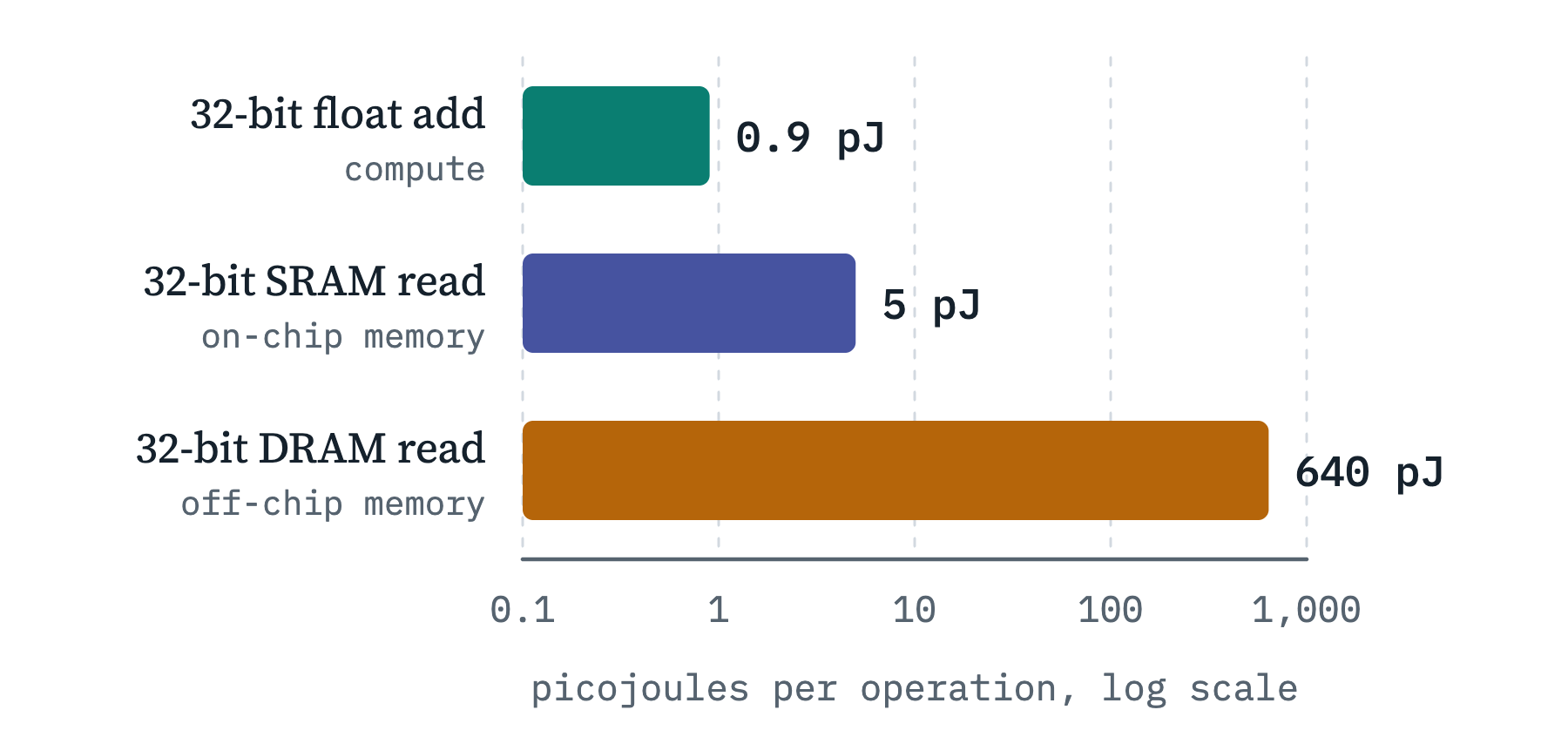
Figure 2. Moving data costs more than computing on it. A 32-bit read from external DRAM takes about 700 times the energy of a 32-bit floating-point add. 45 nm figures from Han et al. (2016), citing Horowitz. Log scale.
One question for every product
At the edge, heterogeneous computing comes down to one design question you can ask about any product.
What should be sensing, and what should be thinking?
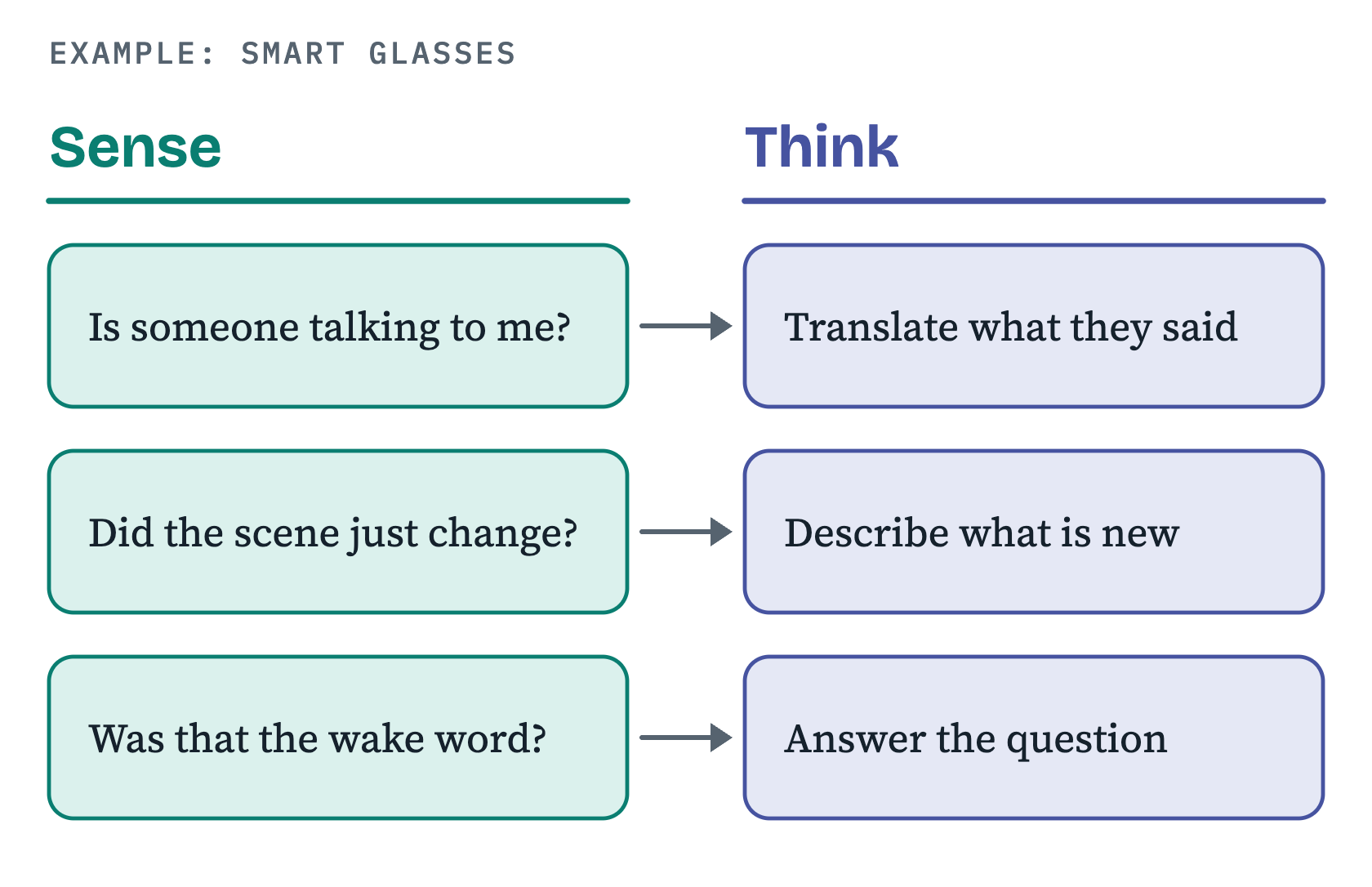
Figure 3. The one design question, filled in for an example product. Example only.
Get that answer right and the rest follows: longer battery life, less data on the network, more privacy and faster reactions.
Eight places that need a sensing brain
Phones got their second brain first because phone makers design their own chips and can build both brains into one piece of silicon. Most products are not made that way. Their makers choose a processor and build around it, so the sensing brain has to sit beside it. Here are eight examples of where that split makes sense, and where a sensing brain such as Akida fits.
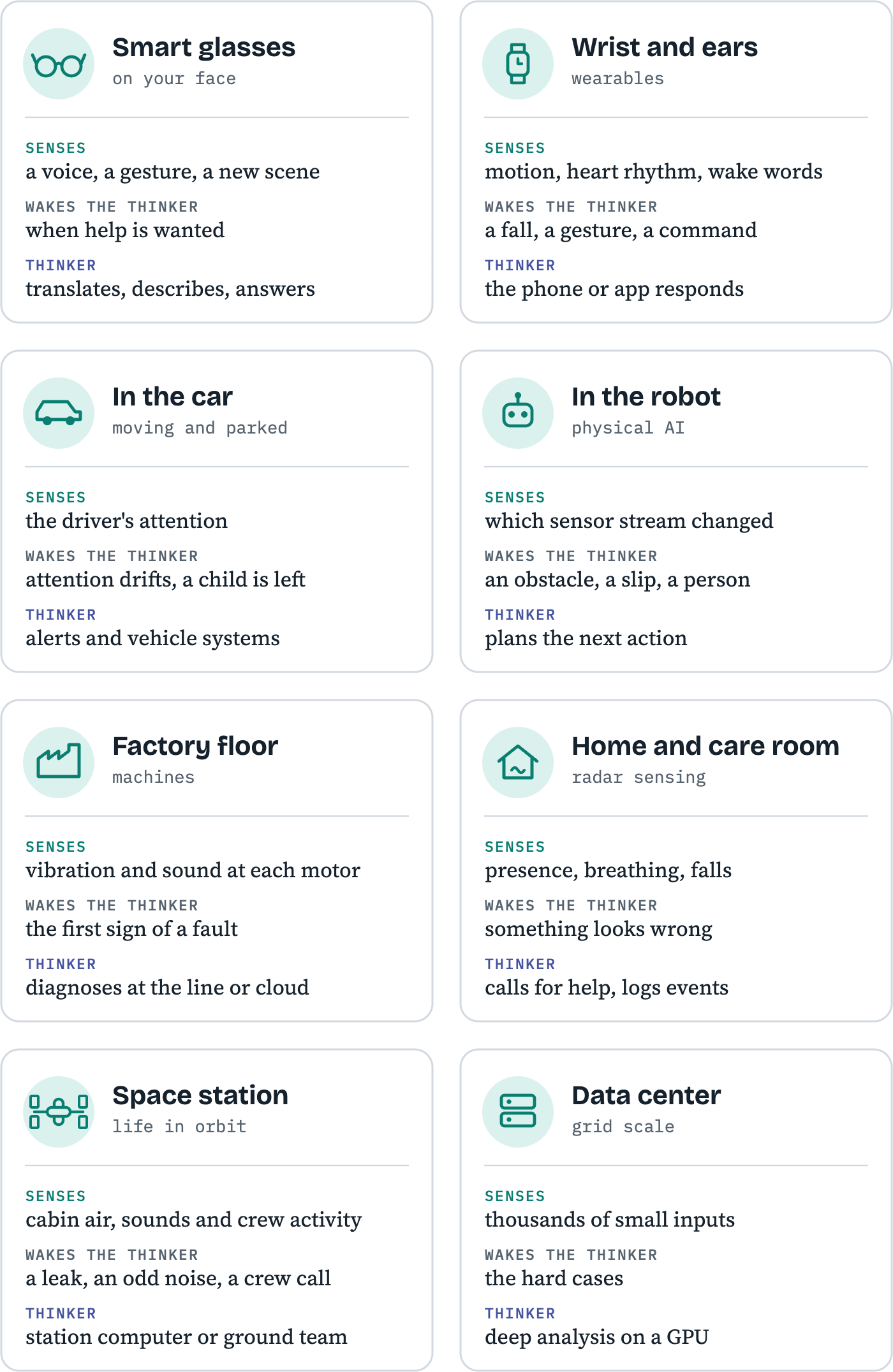
Figure 4. Eight examples of places that need a sensing brain. They show where a sensing brain such as Akida fits; they are not product deployments.
BrainChip already has public work in several of them. The Radar Reference Platform brings Akida to radar object classification at the edge. Akida has been operating on a satellite in low Earth orbit since March 2024. And the open-source Symphony Community Akida Bundle runs Akida chips as managed resources in an IBM Spectrum Symphony grid.
What makes a good sensing brain
Two traits matter most for a sensing brain that sits next to every sensor. Akida was designed around both.
It works when something changes. Akida is event-based. It computes only on non-zero events, so the zeros that occur in a typical neural network cost nothing. With training that encourages sparsity, more than 70 percent of activations can be zero without losing accuracy (Multiple Neuromorphic Chips, One Grid).
It fits any host. Today you can integrate Akida with:
- AKD1500, a co-processor on PCIe and M.2 cards, now shipping
- AkidaTag, a reference platform for always-on smart sensing, open for pre-order
- BrainBoard1500, a compact AKD1500 board for embedded developers
- Akida IP, to build into your own silicon
You can also try Akida on Akida Cloud.
To try it yourself, start an Akida Cloud trial or pick up a development kit at shop.brainchip.com, and clone the public symphony-akida repository.
Stay tuned to the next in the series: our vision of heterogeneous computing and its impact on today’s world, posted every Thursday.
Sources
- Qualcomm, “Unlocking on-device generative AI with an NPU and heterogeneous computing”, whitepaper, February 2024. https://www.qualcomm.com/content/dam/qcomm-martech/dm-assets/documents/Unlocking-on-device-generative-AI-with-an-NPU-and-heterogeneous-computing.pdf
- S. Han, H. Mao, W. J. Dally, “Deep Compression: Compressing Deep Neural Networks with Pruning, Trained Quantization and Huffman Coding”, ICLR 2016; energy figures cite M. Horowitz, ISSCC 2014. https://arxiv.org/abs/1510.00149
- BrainChip News, Spring 2026 (Radar Reference Platform). https://brainchip.com/newsletters/brainchip-news-spring-2026/
- BrainChip blog, “Heterogeneous Computing in Space” (Akida in low Earth orbit since March 2024). https://brainchip.com/blog/heterogeneous-computing-in-space/
- BrainChip, symphony-akida repository on GitHub (Symphony Community Akida Bundle). https://github.com/Brainchip-Inc/symphony-akida
- BrainChip blog, “Multiple Neuromorphic Chips, One Grid, No New Middleware” (activation sparsity). https://brainchip.com/blog/multiple-neuromorphic-chips-one-grid-no-new-middleware/
- BrainChip, AKD1500 Edge AI Co-Processor page. https://brainchip.com/chips/
- BrainChip, brainchip.com (AKD1500 PCIe and M.2 now shipping). https://brainchip.com/
- BrainChip, AkidaTag platform page (pre-order). https://brainchip.com/akida-tag/
- BrainChip shop, BrainBoard1500 product page. https://shop.brainchipinc.com/products/brainboard-1500
- BrainChip, Akida IP page. https://brainchip.com/ip/
- BrainChip, Akida Cloud page. https://brainchip.com/aclp/