



Beyond the Benchmark: Why Designers Measure System Power for Always-On Wake-Up
By Steve Brightfield, Chief Product Officer, BrainChip
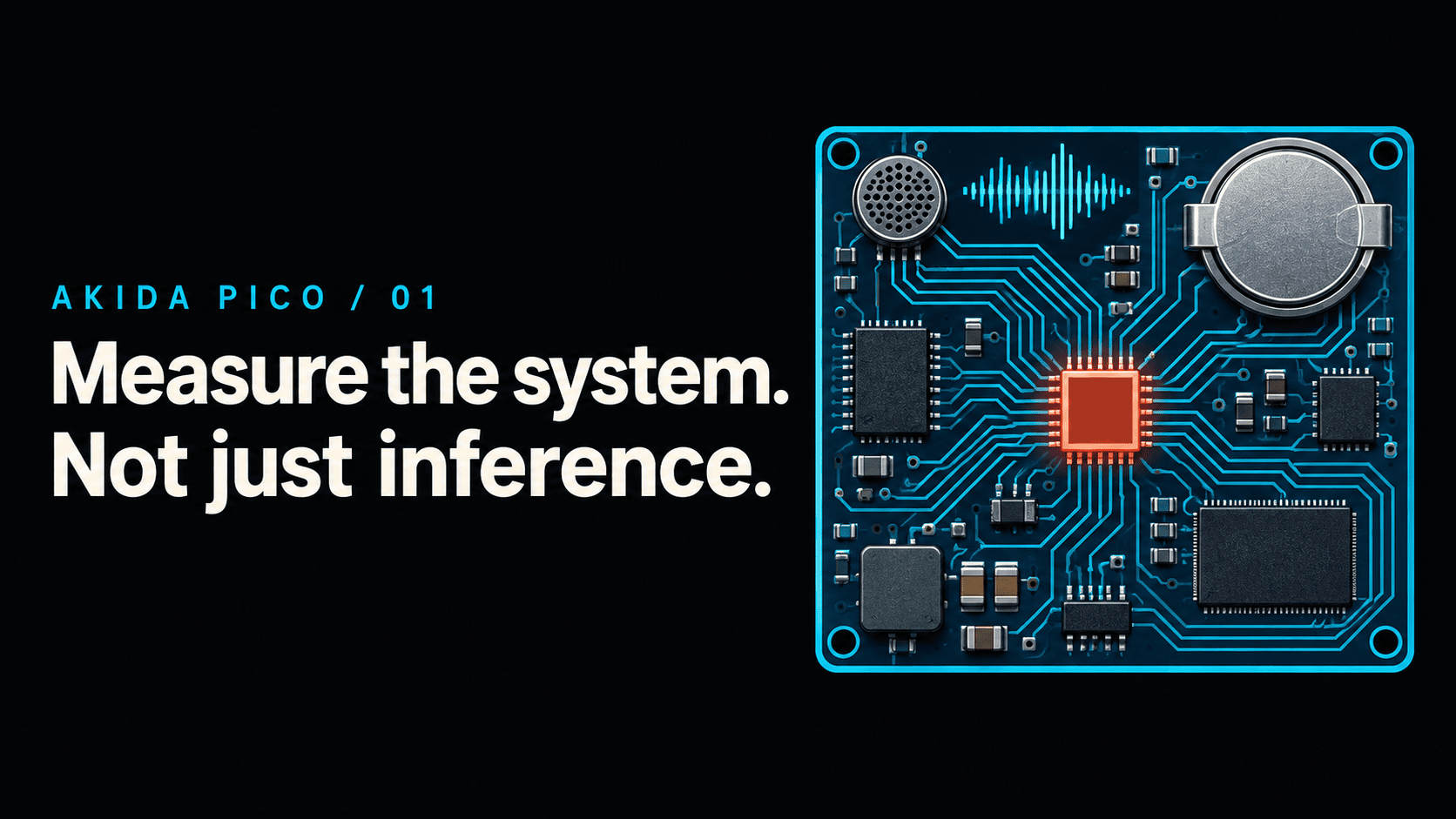
A wake-up device is only as efficient as the system around it. A single-inference benchmark leaves out most of what determines how that device performs in a real product. Integration and programmability matter too, but let’s start with the benchmarks.
The Race to the Smallest Number
Companies increasingly compete on inference benchmarks, quoting ever-smaller energy figures for a single inference as if that alone extends battery life. Start-ups now claim 5 µW to below 1 µW for always-on keyword spotting, using hyper-tuned analog neuromorphic designs on specialized low-voltage processes.
These are impressive numbers. But customers don’t ship an analog core. They ship a product with a microphone, I/O, memory, a power supply and a host processor, and battery life depends on all of it.
How MLCommons Measures tinyML Power
MLPerf Tiny, developed by MLCommons with EEMBC, is the industry reference for ultra-low-power machine learning. It covers four tasks: keyword spotting (DS-CNN on Google Speech Commands), visual wake words, image classification and anomaly detection. Its purpose is to level the playing field with a peer-reviewed process that evaluates the overall implementation. In energy mode, the EEMBC EnergyRunner harness works like this:
- The host loads a pre-processed input dataset into the device under test (DUT), typically a board-level product built around a test chip.
- The DUT toggles a GPIO timestamp pin at the start and end of the inference run.
- An external energy monitor samples current and voltage on the DUT’s board-level supply.
- The host integrates power over the marked window and reports the median energy per inference in microjoules.
This is a fair way to compare compute engines. It is not a measure of battery life, but it is a major improvement over comparing vendor claims built on narrower measurements.
What the Benchmark Leaves Out Matters More
- The microphone. The microphone is the first stage in the signal chain, and it alone draws roughly 30–300 µW, many times the quoted inference power. Below that level, inference savings disappear into the system total, so further reductions deliver diminishing returns.
- Leakage across the chip. Memory, logic and I/O leak every second, whether or not the network is running. At these power levels, that steady drip through inactive circuitry adds up.
- The front end. The keyword spotting benchmark excludes MFCC preprocessing. In MLPerf Tiny, feature extraction arrives pre-computed from the benchmark host.
- The real duty cycle. A wake-word engine runs every few tens of milliseconds, indefinitely, not in a timed burst. Continuous, or average, power is the metric that counts.
- Temperature and power delivery. Converting battery voltage down to what a low-power analog array needs consumes appreciable power on its own. Benchmark results are taken at room temperature on the regulated rail, not at the battery and outside the power management circuitry.
Leakage at 22 nm Sets the Floor
For an always-on function, average power is roughly:
P_avg = (E_inference × rate) + P_leakage + P_sensor + P_power-delivery
Benchmarks report only the first term, and leakage is often larger than inference:
- On a standard 22 nm process, SRAM and logic leak on the order of hundreds of microwatts to several milliwatts, depending on die size, memory content and temperature, each of which can raise that figure significantly. Ultra-low-leakage processes cut this sharply, but still leave tens to hundreds of microwatts.
- Once leakage and the microphone dominate, a tenfold improvement in inference energy barely changes battery life. Only a smaller always-on footprint lowers the floor.
The PMIC Tax: From 3.3 V to 1.8 V, or Even 0.5 V
Benchmarks measure power on the regulated rail, but the battery sees what the regulator draws. Converting a 3.3 V supply to the 1.8 V used by the wake-up core and microphone is not free, and at microwatt loads the regulator choice matters. Stepping down to 0.5 V for an analog AI core adds further overhead.
- Linear regulator (LDO). Load current passes straight through, so efficiency can be no better than 1.8 / 3.3 ≈ 55%. Nearly half the power is lost as heat, regardless of quiescent current. Nanopower LDOs such as TI’s TPS7A02 add only 25 nA of their own.
- Buck converter. A switching regulator trades voltage for current. Nanopower parts such as TI’s TPS62840 run on 60 nA of quiescent current and are rated at 80% efficiency at a 1 µA load (3.6 V in, 1.8 V out).
| Wake-up load at 1.8 V | Load power | Battery power, LDO | Battery power, buck |
|---|---|---|---|
| Akida Pico KWS alone | 8 µW | ~15 µW | ~10 µW |
LDO: 3.3 V × (load current + 25 nA). Buck: 80% efficiency at the 8 µW load.
A quoted inference number says nothing about what the battery actually supplies.
Dedicated or Shared Wake-Up Microphone?
The microphone is often the largest item in a voice wake-up power budget, so how it is shared matters. The most aggressive efficiency claims rely on a dedicated, lowest-power microphone for wake-up, which usually can’t support the full audio features the product needs. There are two common architectures:
| Shared, pass-through microphone | Dedicated wake-up microphone | |
|---|---|---|
| How it works | One microphone feeds the wake-up core in low-power mode. On a keyword, it switches to full performance and passes audio to the host for calls, commands or noise cancellation. | A separate low-power microphone handles wake-up only. The main microphones and audio codec stay off until wake-up. |
| Standby power | The microphone’s low-power mode, 20–100 µW | The wake-up microphone only, which can be the lowest-power part available, such as a wake-on-sound mic at about 10 µW |
| Cost and design | No extra microphone, acoustic port or board space | An extra part, port and placement |
| Design considerations | Buffer the command after the wake word to hand off the stream | A clean hand-off from the wake-up mic to the main microphones |
| Best fit | Earbuds, hearing aids and remotes where space and cost are tight | Products with multi-mic arrays or high-performance audio, where waking the full audio path is expensive |
In both cases, microphone power belongs in the wake-up budget because it runs continuously in standby. With a shared microphone, the wake-up cost is the microphone’s low-power mode, but the product needed that microphone anyway, so no part is added. With a dedicated microphone, the product pays for a second part to keep the main audio path fully off. Akida Pico, as a digital core inside the SoC, supports either approach: it can take the microphone stream directly and pass it through to the host on wake-up.
Stuck with a Discrete Chip
Ultra-tuned analog designs carry a second cost: integration. They typically arrive as discrete parts tied to a single process node, without a mature customer-facing tool flow or model library. That adds board area, I/O power and leakage, and limits what customers can change after launch.
What Customers Look for Instead
Customers need a system-level power budget that meets their battery target while preserving flexibility and ease of integration. That budget must combine active use at a low expected duty cycle with the always-on power analyzed here. For example, a coin cell supports an average of only about 80 µW for one year across the whole product, and less if the device wakes to perform active functions. Developers should evaluate any wake-up solution on:
- Average power at the real duty cycle, measured at the battery, including sensor, leakage, I/O and regulator losses.
- How the microphone is shared between wake-up and active audio, and what it costs in standby.
- A path to integrate as IP inside an existing SoC, in any process node.
- A programmable tool flow and model library, so models can be retrained on the customer’s own data.
Next in the Series
This is the first post in our Akida Pico series on designing always-on intelligence for real products, not just benchmarks. In upcoming posts, we’ll go deeper into how system-level choices shape battery life and deployment.
Learn more about Akida Pico at brainchip.com/akida-pico-announcement.




