



More Spectrum. Less Power: Scaling Modulation Classification with Multiple Akida 1500 Processors
By Jonathan Tapson, Chief Development Officer, BrainChip
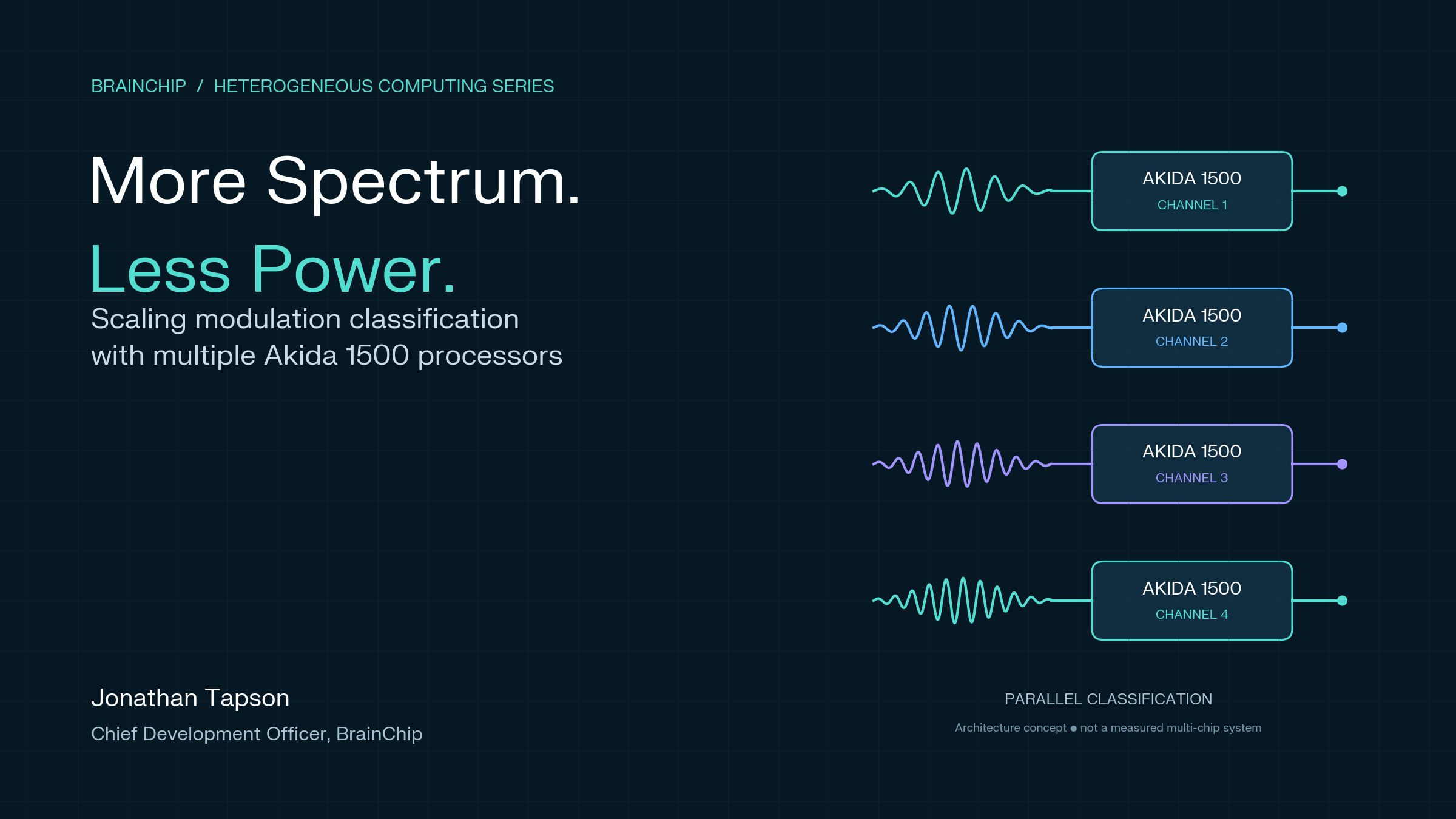
The radio spectrum does not wait for a receiver to catch up. A short transmission can appear and disappear while a system scans another band. Even when a receiver captures it, the opportunity to act can be lost if classification takes too long.
For power-constrained platforms, the answer cannot simply be more general-purpose compute. It has to be a better division of work: detect the signals that matter, route them efficiently, and classify them with processors designed to operate within a tight energy budget.
That is the opportunity behind a heterogeneous receiver built around multiple BrainChip Akida 1500 processors. Our single-chip measurements establish the foundation. Scaling that foundation across multiple channels is the next architectural step.
The Challenge: See More Without Consuming More Than the Platform Can Supply
Automatic modulation classification (AMC) identifies how information is encoded in a radio signal—for example, BPSK, QPSK, or 16QAM. It helps spectrum-monitoring, cognitive-radio, and electronic-support systems characterize the signals they receive.
Coverage and processing capacity create different constraints. A receiver chain sees a limited slice of spectrum. Scanning additional bands creates gaps between visits. Meanwhile, increasing signal activity raises the number of frames a classifier must process.
Adding classifiers can address processing capacity. Continuous coverage across more bands also requires the RF front ends, sampling resources, and data paths to supply those classifiers concurrently. More AI processors alone do not create more RF bandwidth.
A Heterogeneous Architecture: Give Each Stage the Right Job
Rather than asking one processor to handle every task, a heterogeneous receiver divides the workload among specialized components:
- Detect: a low-power front end identifies activity worth examining.
- Organize: a deinterleaver separates detected signals and routes the relevant samples.
- Classify: Akida 1500 processors identify modulation types in parallel.
- Coordinate: a lightweight host manages data movement and results.
The proposed detect-then-classify architecture keeps the classifier focused on detected pulses rather than requiring it to process all incoming radio bandwidth. Parallel classifiers can then support additional receiver channels or higher aggregate signal activity, subject to the rest of the system keeping pace.
The Measured Foundation: Sub-Watt Classification
Our paper, “SWaP-AMC: Sub-Watt Modulation Classification on Neuromorphic Silicon for Low-SWaP Receivers,” evaluates a 4-bit network trained on the 24 modulation types in the RadioML 2018.01A dataset.
At an input rate of 2 million samples per second—1,953 frames of 1,024 samples each—the measurements show:
| Measurement boundary | Power at 2 MS/s | Energy per frame |
|---|---|---|
| Akida 1500 chip | 0.312 W | 0.160 mJ |
| Akida 1500 + Pico 2 complete classifier | 0.472 W | 0.242 mJ |
| Jetson Orin Nano CPU + GPU + SoC rails | 3.17 W | 1.624 mJ |
| Jetson Orin Nano whole module | 5.52 W | 2.828 mJ |
These measurement boundaries matter. Chip power is not complete-system power, and processor-rail power is not whole-module power. The table makes those distinctions explicit rather than treating them as interchangeable.
In a separate live-receiver test, the Akida 1500 achieved 91.17% accuracy on individual frames and 98.69% accuracy across 50-frame windows at signal-to-noise ratios above +10 dB, drawing 314 mW. Each window represents 25.6 ms of samples. The test used a wired link with added noise, not an over-the-air channel.
What Parallel Akida Processors Could Unlock
The first opportunity is simultaneous classification across more channels. With sufficient RF and sampling resources, separate Akida processors can classify separate spectrum slices without sharing a single classifier’s schedule. That can reduce classification bottlenecks and the need to time-share processing across channels.
The second opportunity is aggregate throughput. At its measured peak operating point, one Akida 1500 processes up to 2,743 frames per second at approximately 0.39 W. A simple eight-chip extrapolation yields roughly 21,900 frames per second at approximately 3.1 W of chip power.
For context, the reported Jetson Orin Nano peak is 20,390 frames per second. The eight-chip projection is not a demonstrated system benchmark or a complete-platform power comparison: it excludes RF acquisition, host processing, interfaces, and other supporting circuitry. It assumes that data delivery scales without introducing a new bottleneck.
Parallelism increases aggregate capacity; it does not automatically reduce the latency of an individual inference. That distinction matters when specifying a receiver for short-lived signals.
Why Efficiency Starts Inside the Classifier
The Akida implementation keeps the network on-chip and skips computation for zero activations. The work also demonstrates how software and hardware choices reinforce one another:
- Pipeline balancing reshaped the network around its slowest stage, improving throughput by 3.5× and energy efficiency by 2.7×.
- Quantization-aware training improved the 4-bit model’s accuracy on the RadioML test split from 37.40% to 61.54%.
- Activation sparsity reduced energy per frame by 19% when the training penalty removed 20% of nonzero activations.
The RadioML test-split accuracy and the live-receiver accuracy come from different evaluation conditions. They should not be read as directly comparable scores.
The Host Can Make—or Break—the Power Budget
Efficient accelerators do not guarantee an efficient system. As the classifier’s power falls, the energy used to prepare samples, move data, and coordinate devices becomes more important.
In the measured single-chip implementation, a Raspberry Pi Pico 2 microcontroller receives, normalizes, and feeds frames without an operating system. The complete classifier draws 472 mW. That result provides a practical starting point for evaluating lightweight orchestration, but it does not establish that the same host can feed multiple chips at full rate.
A multi-chip design therefore needs an end-to-end budget: RF front ends, converters, memory, interfaces, host, and classifiers. The goal is not just to replicate a low-power chip. It is to preserve its advantage across the entire data path.
The Next Step: Scale the Architecture, Not Just the Chip Count
Sub-watt modulation classification is already demonstrated on a single Akida 1500, including a complete 472 mW classifier implementation. The next question is how effectively that measured efficiency can translate into a multi-channel receiver.
For drones, handheld systems, and other size-, weight-, and power-constrained platforms, the opportunity is clear: combine specialized processing stages, keep coordination lightweight, and add classification capacity where the application needs it.
That is the value of heterogeneous computing—not putting every task on the same processor, but giving each task the right one.
Explore Akida 1500 on the BrainBoard 1500, and contact BrainChip to discuss modulation classification for your receiver architecture.
Research: “SWaP-AMC: Sub-Watt Modulation Classification on Neuromorphic Silicon for Low-SWaP Receivers,” by Aras Pirbadian, Amir Naderi, Jonathan Tapson, Anusha Gopal, M. Anthony Lewis, and Nikunj Kotecha.